“Either the super-traditional African woman with the big earrings or scarification…or this other woman which kind of is a pin-up, a very vile erotic sexualized pinup. These two objectifications are placed together and there’s this kind of dialogue going on between them … They’re very interesting to look at but ultimately I remove the most titillating parts. The central part of the shot is removed and what you have is this synergy between the two. And I think it’s a fantastic kind of harmony that happens and it makes people reflect on both things without replicating the objectification of either one of them.”
funny enough i had just gotten hip to (Kenyan-born, Brooklyn-based visual artist) Wangechi Mutu thanks to a BBC story a couple of weeks ago. i'm particularly struck by her 2006 series "The Ark Collection," which they show in the video. i mean, it's really really amazing what she's doing here, how she outlines these mythologized images of black women/black women's sexuality and presents them, but somehow manages to not reinforce the ideas behind these these images - like she says, a reproduction that manages not to reproduce the oppression of the original images. and she does it in a way that makes you think, makes you really think about where these images of black womanhood come from and who made them and what/who they made them for, and good lord just how loaded our skin is. and im sitting here wondering how the fuck does she DO it???
because it's something i've been thinking about a lot lately. about black women and our bodies and is it ever possible for us to be a neutral subject/object, especially where visual art is concerned. if we can ever present ourselves as just that, ourselves, and not have to/automatically stand for a whole host of over issues (desirability/undesirability, nympho/mammy etc.). and if you want to try and challenge these things, if one, as a black woman, decides she wants to use either her or the black female body to challenge these things, how do you do that without the challenge being co-opted by the very act of being seen?
this better explains what i'm getting at:
When you look at images like Yo Mama of Yo Mama at Home and see a woman or a child who is Black, their blackness influences how it is you understand their nudity, as well as their potential relationship to each other. In a way though, through categorizing them, viewers kill them, effectively annihilating their conceptual freedom by eliminating their ability to mean anything other than what they are destined to mean.*
so it becomes this thing where like, i want to be seen but being seen means that, in the process of being seen, more than likely/at some point i am going to be seen for what i am not. no matter what. and i feel like this must be taken into account whenever you talk about the representation of black women and colored women's bodies, in any place or space - in music videos, at the grocery store, in times square, wherever.
i think that's one reason why Mutu's "Collection of the Ark" works so well. because she anticipates this, and confronts you with it. pulls a kind of bait-and-switch, because when you go to look, what you expect isn't there, and the definition of this body you were building in your head gets interrupted mid-programming and you have to figure out what these images and what they have to do with each other, and that's really fucking brilliant.
but this "annihilation" isn't inevitable, right? obviously it's not, Mutu does it. who else does it? and how?
the essay i just quoted goes on to talk about subjectivity and how it's key to being seen, really seen:
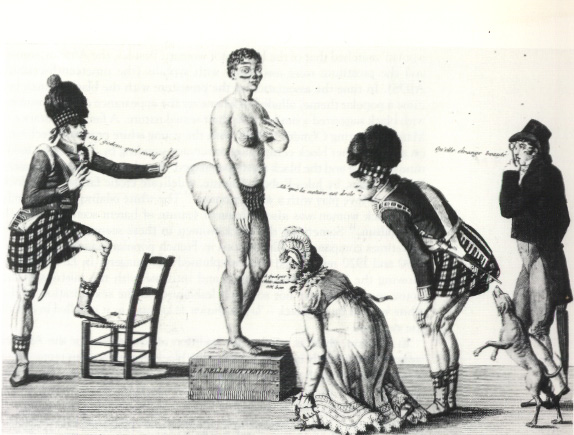
This kind of "self" disclosure which took place a hundred years ago could scarcely be understood as such then, because Black bodies on display during the nineteenth century were not understood to have subjectivity: Aboriginals, African, Indians and other "exotics" occupied rudimentary locations in evolutionary and aesthetic trajectories, but each was believed to lack the essential element of subjectivity - intellect - which is required to distinguish humans as self-aware and sentient.*
and that's it, isn't it? subjectivity, or, i guess, self-determination. the ability to define oneself for oneself and representing only what one wants to represent. the thing we need to make this happen is the thing that's continually denied us. even the Sofia Maldonado is perfect example. it takes a lot of fucking subjectivity to get some nail art done, or invest in some clothes that'll hug your curves just right. (and yes there's always the issue of beauty standards and who determines them and if it's possible to make personal beauty decisions completely independent of the patriarchal blah blah blah, but i also know that i like getting my nails painted outlandish colors and wearing tightly fitting clothing because it ALSO makes me feel GOOD) but the people who looked at the mural, at least the people like Very Concerned Black Man of the Community Tony Herbert, looked at it and only saw the possibility of objectification and decided that the subjectivity of the women the mural depicted wasn't worth it, and demanded it be taken down because "Women should be depicted with cell phones and briefcases, that's to show the professionalism of how women have broken the glass ceiling to accomplish what they've accomplished, not to come back to this."
i cannot occupy the public sphere if i am not the woman you want me to be be.
i cannot occupy the public sphere if i am the woman you want me to be.
thus what is a sister to do?
ASSERT SUBJECTIVITY. RETURN THE GAZE.
but how?
how do i get you to see me, how do we get us to see us when we all have been trained to the point of pathology to mis-see?
* "What is my Legacy? Transient Consciousness and the "Fixed" Subject," Bob Meyers. inGendered Visions: The Art of Contemporary Africana Women Artists, ed. by Salah M. Hassan



yes and yes and yes! we're on the same page with this. i wish we could meet. or at the very least chat via aim about our ideas.
ReplyDeleteI am always thinking about this.
ReplyDeleteWhen I do, I am reminded of my grandmother. A gorgeous, classy, and hourglass (but never obsese) woman who was put together, but shy- smart and a good mother, an excellent sales woman at JC Penny's for years. She, in my mind, is the "average" black woman. Neither sex symbol, or afro centric queen- just a woman who knew who she was, had pride, and loved her family. She was also very sexy, without being trashy...
I try to emulate her everyday. Basically, I am obsessed with her and how she "defined" her role as an American black woman.
What really disgusts me is that we are setting our "daughters" up for failure when we patronize a media that does not accept the many roles, faces, bodies, and ideologies of black women. I have decided to quit watching shows and movies that disgrace myself and other "sisters."
I am a mixed "light skinned" woman, whatever- I am not Beyonce, Halle, or Lena. I am not a sex symbol or hateful towards my mother/father- nor do I think I am "better" than anyone else. I cut my hair short for many reasons- I hate the entire "good hair," thing. So many black men have told me to never cut it, I did it to spite our society. I love my short hair. Someday, I want to be brave and shave my head. My dad always said, "you are more than your hair," yep.
I suppose we are the last judges of ourselves. When we support our sisters we uplift ourselves and them. When we support black women writers, artists, and students we are literally giving back.
(This did NOT need to be so long. Sorry)
xoxo
Katie
To assume that whenever a female wears something tight-fitting is an objectification of the female form by the male is assuming the human male is as omnipresent (even in wardrobe decisions) as the god he wishes to be... too bad the REAL "god" gave unto us free will whereas the human male taketh away, especially by freely making this assumption of ultimate domination and power...
ReplyDelete...also yay for your blog!